What AI Is Running in Your Company?
Shadow AI and ungoverned agents are accumulating risk you can't quantify. ARIS finds what's running, measures the exposure, and gives you control where it matters.
Agents discover with ARIS. ARIS uses your internal knowledge to assess risk. Integrates with control services for enforcement.
The Governance Gap
AI adoption is accelerating. Governance has not kept up. The result is risk your business is carrying without knowing how much.
Unchecked Speed
Teams adopt AI faster than governance can follow. Every day that gap widens, unquantified risk compounds.
Shadow Agents
Born from experimentation or deployed without approval. Either way, they operate outside your risk framework.
Inventory Void
No reliable inventory of agents exists. Without one, you cannot measure your exposure, let alone manage it.
Policy Gap
Policies exist on paper. At runtime, nothing enforces them. The gap between intent and reality is where risk lives.
What ARIS Does
Surface the risk you're carrying. Apply control only where it's needed.
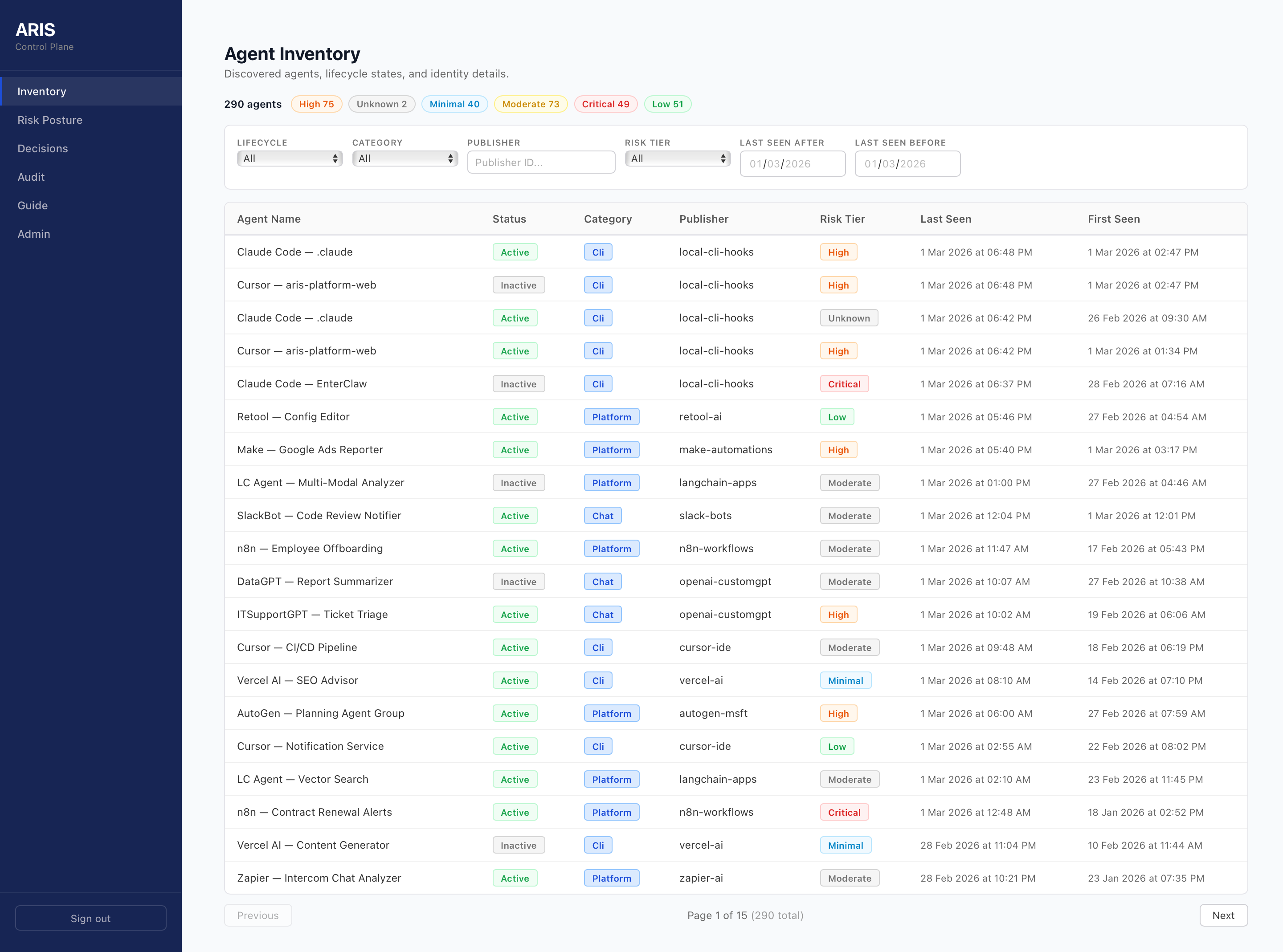
1. Discover
Connect to code repositories, IaC, CI/CD, cloud, and SaaS to find every AI agent in your environment. You can't govern what you don't know about.
Out-of-the-box Integrations:
- Claude Code
- Cursor IDE & CLI
- Gemini CLI
- Kimi Code
- n8n
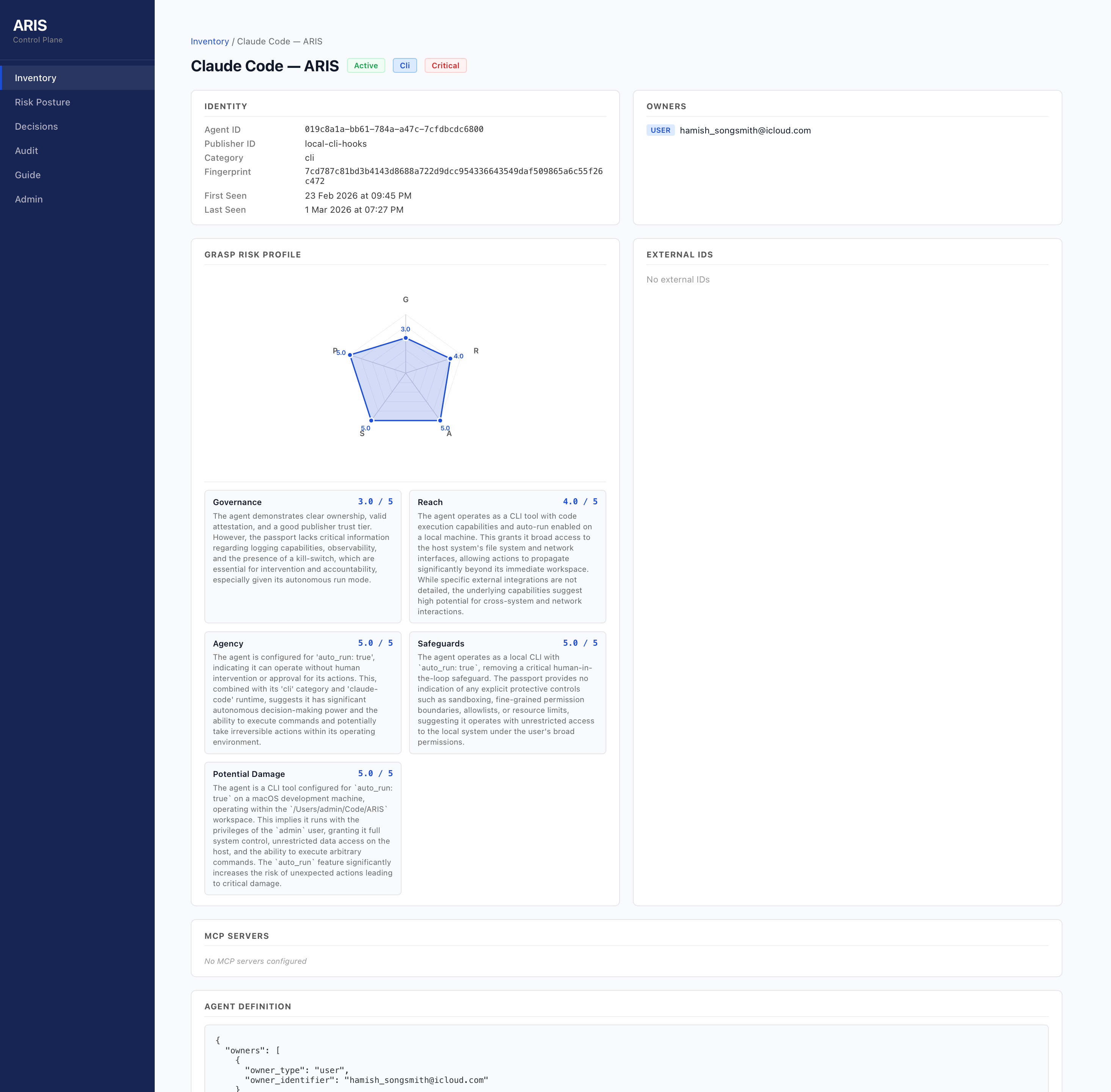
2. Profile
Quantify the risk each agent carries. ARIS generates a GRASP profile covering governance, reach, autonomy, safeguards, and potential damage so you can make informed decisions.
Risk Assessment Dimensions (GRASP):
Can we observe and intervene?
What can it touch (explicit + implicit)?
How autonomous is it?
What limits damage when it acts unsupervised?
What's the credible worst case?
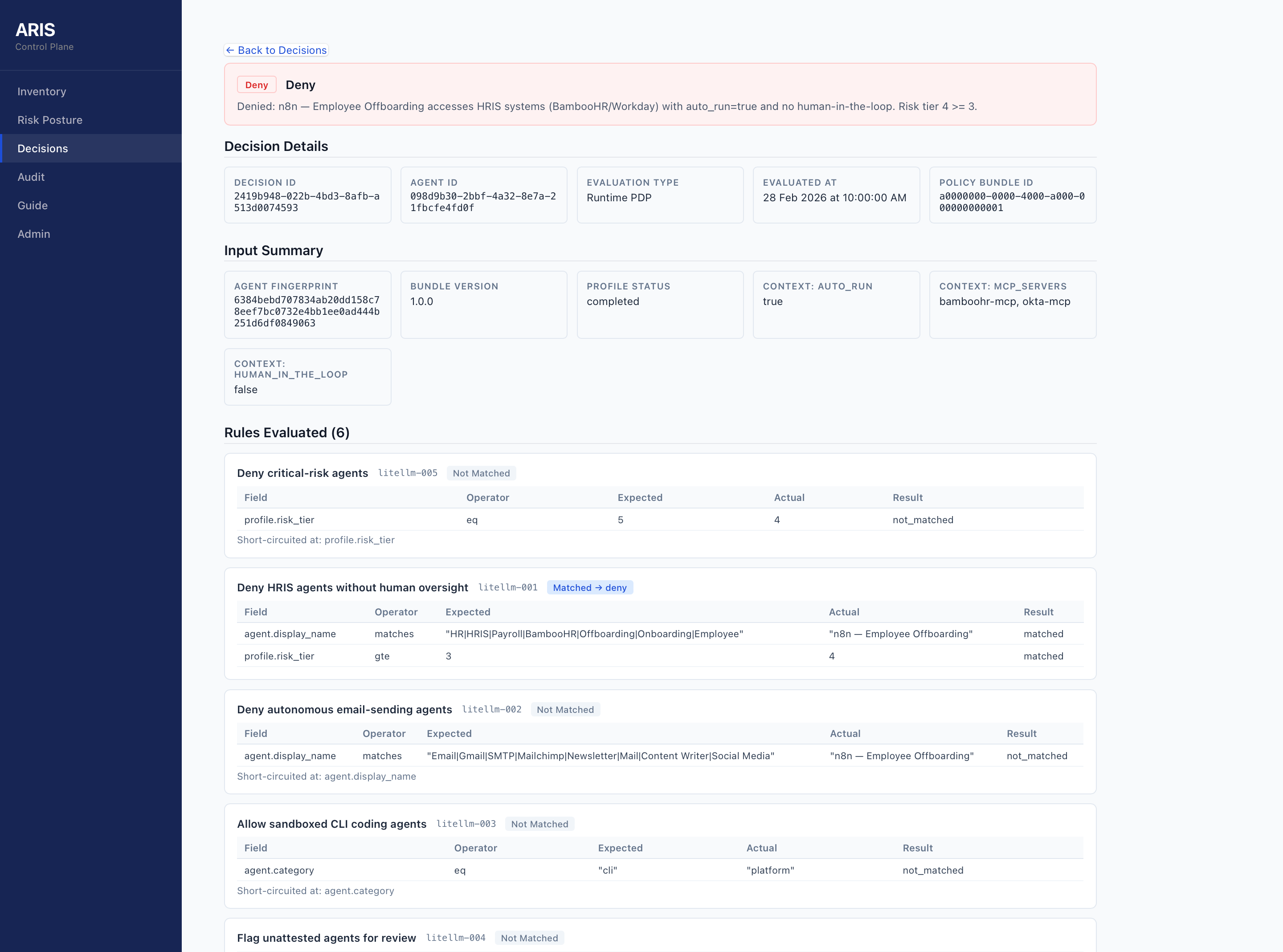
3. Control
Intervene where agents stray outside acceptable risk. Revoke LLM access via proxy, raise alerts, or disable workflows directly. Controls are targeted, so compliant teams keep moving.
What ARIS Can Do:
Your Data, Your Environment.
ARIS is designed for the enterprise. We prioritize security and privacy above all else.
- Deployment: Fully self-hosted / On-Premise (Docker/Kubernetes).
- Data Privacy: ARIS has no cloud services. We do not collect any data from your environment. ARIS runs in your environment and analyzes metadata locally.
- Compliance: SOC 2 Type II (In Progress).
- Architecture: Zero-trust design. Read-only access modes available.
- Access control: SSO & RBAC enabled.
How ARIS Differs
Other tools assume you already know what agents are running. ARIS starts from the assumption you don't.
API Gateways & Proxies
Control traffic: rate limits, routing, request-level auth. They don't know which agent is calling or what risk it carries.
Agent Identity & Credential Platforms
Solve how an agent proves who it is. Tokens, OAuth for non-human identities. They assume you already have a complete inventory.
ARIS
Starts with discovery. Finds agents across your environment, profiles their risk, and maintains a live inventory. Provides the visibility layer that gateways and identity platforms need to make better decisions.
Start With a Controlled Pilot
In two weeks, we show you exactly how much AI risk you're carrying and give you a plan to manage it.
The Process
- 1
Connect ARIS
Deploy ARIS in your environment and connect to selected systems in read-only mode.
- 2
Generate Inventory
Automatically discover and catalog every AI agent across connected systems.
- 3
Build the Risk Posture
Assess each agent using GRASP to quantify your actual risk exposure.
- 4
Deliver Assessment
Receive a full Risk Assessment Report with executive recommendations and prioritized next steps.
Pilot Deliverables
- Agent Inventory
- Risk Heatmap
- Executive Recommendations
Timeframe: 2 Weeks
No production enforcement during pilot.
Frequently Asked Questions
What is a GRASP Analysis?
GRASP is a shared language for assessing AI agent and agent system risk—turning vague fear into concrete controls. It gives technical and non-technical stakeholders a common framework to reason about what an agent can actually do, what constrains it when it's wrong, and whether the resulting risk is acceptable.
The five dimensions—Governance, Reach, Agency, Safeguards, and Potential Damage—form a risk profile rather than a pass/fail checklist. ARIS uses GRASP to assess every discovered agent across your environment.
Does ARIS require deploying agents?
For most integrations, no. However, for some services the deployment of a small service is required to capture sufficient context for GRASP risk analysis. We can clarify requirements during your pilot.
Is this SaaS?
No. ARIS has no cloud services. It deploys entirely within your environment, and we do not collect any data from your environment.
Is this observability?
No. Observability watches what agents do at runtime. ARIS discovers which agents exist, quantifies their risk, and enforces governance.
How does ARIS exert control?
It depends on the agent and your environment. Tools such as Kong and LiteLLM provide intermediary control—ARIS can revoke LLM access by removing auth for agents that route through them. Platforms like n8n allow direct control (e.g., disabling workflows). Not all integrations support enforcement.
AI Adoption Without Visibility Is a Liability.
Accelerate AI Adoption. Know the Risk.
ARIS gives you the visibility to move fast and the controls to intervene only when it matters.
Book a Pilot Assessment